


Refillable vs Bound Leather Journal – Which Is Better?
If you've been shopping for a leather journal, you've probably run into a choice that feels more complicated than it should: do you go with a refillable leather journal, or stick with a traditionally bound one? Both have genuine appeal, and the right answer depends on how you write, what you value, and how long you want your journal to last.
This guide breaks down the real differences so you can make a decision you'll actually be happy with.
Refillable vs Bound Leather Journal
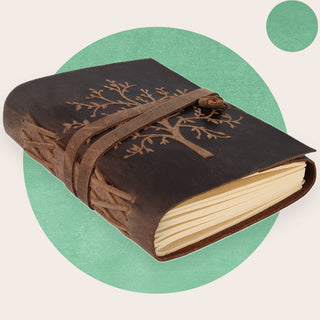
A bound leather journal is a fixed number of pages permanently attached to a leather cover. Once the pages are full, the journal is complete. You start fresh with a new one.
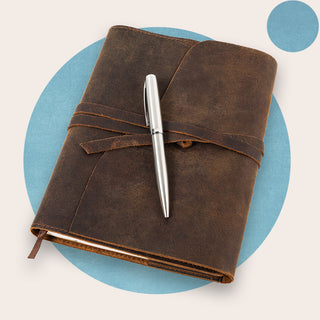
A refillable leather journal uses a leather cover designed to hold removable paper inserts or notebooks. When you finish a set of pages, you swap in a new insert and keep using the same cover. The leather becomes a long-term home for your writing rather than a one-time purchase.
Both can be made from full-grain, top-grain, or genuine leather. Both can look and feel exceptional. The distinction is structural, not qualitative.
Why Choose a Bound Leather Journal
Simplicity and completeness
There's something satisfying about a bound journal. You buy it, you fill it, and when it's done, it represents a finished chapter, something you can date, shelve, and return to later. Writers and journalers who like the idea of a physical archive often prefer bound journals for this reason. Each volume stands on its own.

Bound journals also tend to be more accessible at a range of price points. Because the cover and paper are sold together, manufacturers can produce them in higher volumes, which generally keeps costs down. If you're new to leather journals and want to try one without a significant upfront investment, a bound option is often the easier entry point.
A more unified aesthetic
Bound journals are typically designed as a single cohesive object. The paper weight, ruling style, and cover are chosen together, so the whole thing feels intentional. For people who care about that kind of consistency, this matters.
Easier to find
Bound leather journals are widely available, both online and in stationery stores. Refillable journals, especially high-quality ones with good insert availability, require a bit more research to source well.
Why Choose a Refillable Leather Journal
Long-term value
This is where refillable journals make a compelling argument. A quality leather cover can last decades. Full-grain leather develops a patina over time, it takes on character from use, softening and deepening in color in ways that make it look better with age, not worse. When you invest in a well-made refillable cover, you're not replacing it every few months. You're buying something that could realistically last your entire writing life.
Over time, the math tends to favor refillable journals. Replacement inserts are usually less expensive than buying complete bound journals of equivalent paper quality. If you write regularly, those savings add up.
Paper flexibility
One of the most underrated advantages of refillable journals is the ability to customize your paper. Prefer dot grid for bullet journaling? Switch to it. Want lined pages for a travel diary and blank pages for sketching? You can do both, using the same cover. With bound journals, you're locked into whatever paper came inside.
For people whose writing habits shift across projects, this flexibility is a significant practical benefit.
Sustainability
Buying a single leather cover and replacing only the paper insert is a more sustainable model than purchasing an entirely new journal every few months. Less leather production, less packaging, and less waste overall. This isn't the only reason to choose refillable, but it's worth considering if that kind of thing factors into your purchasing decisions.
Sentimental continuity
Some journalers find deep value in using the same physical cover across years of writing. There's a continuity to it. The cover holds the memory of everything written inside it, even after the inserts are swapped out. If you're someone who develops an attachment to your tools, a refillable journal can take on a kind of personal significance that a bound journal simply can't.
Common Disadvantages of Refillable and Leather Bound Journals
The downsides of bound journals
The most obvious limitation is longevity, or the lack of it. Once a bound journal is full, it's done. For heavy writers, that might mean buying several journals a year. At premium price points, that gets expensive quickly.
There's also a quality ceiling on the leather. Because bound journals need to remain affordable as complete packages, manufacturers sometimes cut costs on the cover material. You can find beautiful bound leather journals, but the best leather tends to appear on refillable covers, where the cover is the primary purchase.
The downsides of refillable journals
Refillable journals require more upfront cost and more ongoing management. A good refillable cover costs more initially than a comparable bound journal. You'll also need to source compatible inserts, which isn't always straightforward. Not every insert fits every cover, and finding the right paper quality can take some trial and error.
The mechanism itself can occasionally be a point of frustration. Some refillable systems use rings, snap closures, or leather ties that work well but require a moment to set up and adjust. If you want to just open a journal and write without any fuss, a bound journal wins on convenience.
There's also the question of feel. Some refillable covers hold their inserts more loosely than others, which can create a slightly less substantial feel when writing. A well-engineered cover minimizes this, but it's worth paying attention to construction quality before buying.
Who Should Buy a Bound Journal
A bound leather journal is a good fit if:
- You prefer a low-maintenance, grab-and-go writing experience
- You like the idea of keeping finished journals as a physical record
- You're budget-conscious or new to leather journals
- You write infrequently enough that a single journal lasts a meaningful amount of time
Who Should Buy a Refillable Journal
A refillable leather journal makes more sense if:
- You write regularly and go through paper quickly
- You want flexibility over paper type and ruling style
- You're looking for a long-term investment rather than something you'll replace
- You prefer the idea of a single cover that evolves with you over time
- Sustainability is a priority

What to Look for in Either Journal
Regardless of which direction you go, a few quality markers are worth keeping in mind.
Leather type: Full-grain leather is the highest quality. It's cut from the top layer of the hide and retains the natural grain. It's more durable and develops a better patina than top-grain or genuine leather. For a refillable journal you plan to use for years, full-grain is worth the extra cost.
Stitching and binding: On a bound journal, look at the binding. Sewn signatures lie flatter and last longer than glued bindings. On a refillable journal, check how the insert is secured, it should stay firmly in place without feeling forced.
Paper quality: Don't overlook the paper. Even the most beautiful leather cover is frustrating to use if the paper bleeds or feathers. Look for paper weight of at least 90 gsm if you use fountain pens or brush markers.
Closure: Both types commonly use a leather strap-and-button or elastic closure. Make sure the closure keeps the journal securely shut without damaging the pages over time.
Refillable vs Bound Journal - The Bottom Line
Neither format is objectively better. It all comes down to your habits and priorities. If you value simplicity and like the satisfaction of completing a journal, a bound leather journal does exactly what you need. If you're investing in something that improves with age and adapts to how you write, a refillable cover is hard to beat.
The good news is that quality leather journals, in either format, are built to be used. Pick the one that matches how you actually write, and you'll get your money's worth.
Share


